

The State of Test Optional: Do SAT and ACT Scores Still Matter?
If you are a parent of a high schooler today, you’ve likely heard the term "test optional" dozens of times. It sounds like a relief: one less thing to worry about in an already stressful process. However, many families are left wondering: if a school says tests are optional, do the SAT and ACT actually still matter? The simple answer is yes, they do.
While there is plenty of nuance to explore, the reality of college admissions today is that test scores remain a powerful tool for applicants. Here is a guide to test-optional policies and how to decide whether your student should hit "submit" on those scores.
Two Different Worlds: Required vs. Optional
First, it is important to recognize that not all colleges are test optional. Many highly selective colleges and large state schools have returned to requiring test scores. In these cases, the rule is simple: if they require them, you must provide them to be considered. Here’s a regularly updated database of testing policies by college. This table goes into depth about each policy, with links to each college’s admissions website.
The confusion starts with schools that remain "test optional." Many families interpret this to mean the college doesn't care about scores, but that framing is often misleading. Think of it like this: colleges don't technically "require" you to take rigorous classes, receive straight As, or compile a resume full of leadership positions to apply, but you know those things significantly help your chances at selective schools. Tests are no different. They are a piece of evidence that can strengthen an application.
Want The Data? Find The Common Data Set
To figure out how much a "test-optional" school actually values scores, you need to look at their Common Data Set (CDS). This is a document that nearly every college publishes annually, and Section C9 is where the critical testing component lives.
When you find a school’s Common Data Set (just Google it), look for two key things:
The percentage of students who submitted scores: Add the percentage of students who submitted SAT scores to the percentage who submitted ACT scores.
The 25th to 75th percentile of scores: This tells you the range of scores for the middle 50% of students who actually enrolled.
A Tale of Three Schools: Bucknell, Lafayette, and Franklin & Marshall
To see why the percentage of submitters matters, let’s look at Bucknell University, Lafayette College, and Franklin & Marshall College. All are similar sizes (2000-4000 undergraduates), similar locations (small towns/cities in PA), and similar selectivity (all around 30% acceptance rates, based on recent data). All are technically test optional, but the data (from 2024-25 and 2025-26 Common Data Sets) tells a different story:
Lafayette and Franklin & Marshall: Only about 35% of enrolled students submitted scores. These schools are "truly" test optional.
Bucknell: Over 85% of enrolled students submitted scores. This high percentage tells us that, regardless of what the school says publicly, Bucknell is a test-preferred college. They might not technically require tests, but unless you are a specialized recruit (like a sought-after athlete), good luck getting in without them.
While these are all smaller colleges, tests often carry even more weight at large universities. A school receiving 100,000 applications doesn't have the bandwidth to contextualize every transcript. Scores give them a quick, standardized signal across applicants from thousands of different high schools.
Deciding When to Submit: The 25th Percentile Rule
A common mistake is looking at the average score (the 50th percentile) and only submitting if you are above it. This is flawed because test-optional data is heavily skewed.
Students with lower scores generally don't submit them, which artificially inflates the school’s published "average". If you want a more accurate picture of what a school’s "real" requirements are, look at their 2019 Common Data Set to see what their scores were before the world went test optional.
Here, we did a much deeper dive into what the 25th and 75th percentiles actually represent at test-optional colleges. Spoiler: they’re very inflated, meaning submitting what you think are “low” scores might look a lot better than submitting no scores.
The Rule of Thumb:
If your score is at or above the 25th percentile: It is generally a no-brainer to submit.
If your score is below the 25th percentile: You might still consider submitting if your grades are slightly weaker than your scores, if you attend a school with significant grade inflation where an SAT/ACT score can help you stand out, or if your scores are exceptional by the standards of your high school. You might also consider submitting when applying to a college like Bucknell, which may technically be “test-optional” but has shown through data disclosures that it strongly values scores.
The Grade Inflation Problem
Test scores don’t exist in isolation. They form the academic profile in conjunction with course rigor and grades. That means grades factor directly into whether submitting makes sense.
If your grades are weak, a strong test score becomes more important, giving colleges a second data point that says "this student can handle rigorous academic work." The flip side seems obvious: if your grades are excellent, scores should matter less, in theory.
Here's the catch: almost every family believes their student falls into the "excellent grades" category. And increasingly, they're right. The problem is that so does everyone else.
Grade inflation has made high school GPAs nearly useless as a differentiating signal, with A's now the single most common grade by a wide margin. And the grade compression carries into college admissions. The University of Georgia's 2024-25 Common Data Set (section C11) shows what competitive applicant pools actually look like: 85% of enrolled students had a 4.0 GPA. That’s straight A’s for all of high school. Zero B’s, ever!
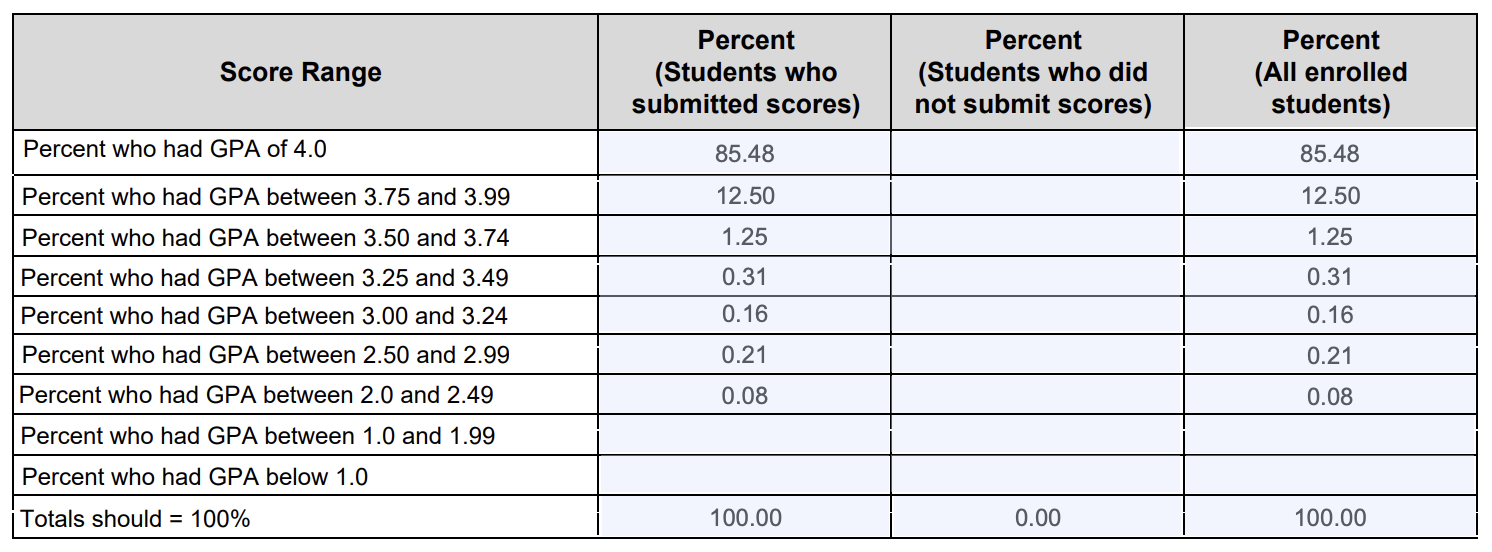
When the floor is already that high, there's almost no room to stand out on grades alone. No wonder University of Georgia has gone back to requiring test scores. A strong test score is often the only data point left that can actually separate you from the pack.
Your Best Resource: The School Counselor
Finally, don't guess in a vacuum. Your high school counselor has access to platforms like Naviance or SCOIR, which show data specific to your high school.
Ask your counselor direct questions: "In the last three years, what percentage of students from our school got into [College X] with scores? Without scores? What was the average GPA of those students? What scores did they submit? What scores did they withhold?" Because grading scales vary so much—where a 4.3 at one school might be "weaker" than a 3.5 at the school next door—your counselor’s local data is the most relevant information you can get. Depending on the platform, you may be able to dive into this data yourself.
Beware of sample sizes, keeping in mind that 1) the data will be most helpful for colleges that many students from your high school apply to, and 2) if you apply to a school that rarely sees applicants from your specific high school, they may not easily understand the nuances of your grading system. A test score provides a "universal language" they can use to verify your academic ability.
The Final Word
Here’s one more link to all testing policies by college.
Test optional is a policy. Whether scores matter is a different question entirely, but now you have the tools to answer that question.